
Getting to know CMMI Maturity Model: A Guide to Process Improvement.
The present day organizations are operating in a competitive environment where efficiency, quality and consistency are very crucial to success. Companies interested in providing quality products and services have to embrace structured systems and keep on advancing them. The CMMI maturity model is one of the most known frameworks that could be used to achieve this goal.
CMMI maturity model assists organizations in measuring the internal processes and enhancing them. It offers a systematic process which will bring the companies to a greater level of operational efficiency, project management and quality of products. It is a framework used by companies in various industries such as software development, information technology services, manufacturing and consulting to tighten their processes and deliver steady outcomes.
This blog describes what the model is, why organizations embrace it, and how it contributes to the growth of businesses in the long term.
Table of Contents
What is CMMI Maturity Model?
The CMMI maturity model is an abbreviation of the Capability Maturity Model Integration. It is a process improvement model aimed at assisting organizations in coming up with improved processes and projects management. The model aims at enhancing how work is designed, implemented, supervised and managed.
The CMMI maturity model does not support ad-hoc approaches that an organization may use to operate its business; it promotes a structured system of running an organization. With the help of the identification of practices and guidelines, companies can minimize risks, enhance productivity, and deliver projects on time and on budget.
The model was designed to give organisations an effective road map on how to enhance performance. It enables the businesses to gauge the maturity of their processes and reveal areas where they require improvement.
The reason why organizations embrace the Model.
The reason why companies use the CMMI maturity model is that it assists them to be more efficient and earn the trust of the clients. An organization that adheres to clear processes is capable of providing consistent and quality results.
Among the major benefits that the CMMI maturity model offers is that it assists businesses in eliminating errors and enhancing uniformity in the activities that they are engaged in. When the required standardization of procedures is implemented, the work of teams will be more effective and will not waste time on irrelevant delays.
Credibility is another significant advantage. Most of the clients in the world market would want to deal with organizations subscribing to accepted models. The adoption of CMMI maturity model is used to show that an organization is determined to achieve quality, process discipline and continuous improvement.
The Five Levels of Maturity
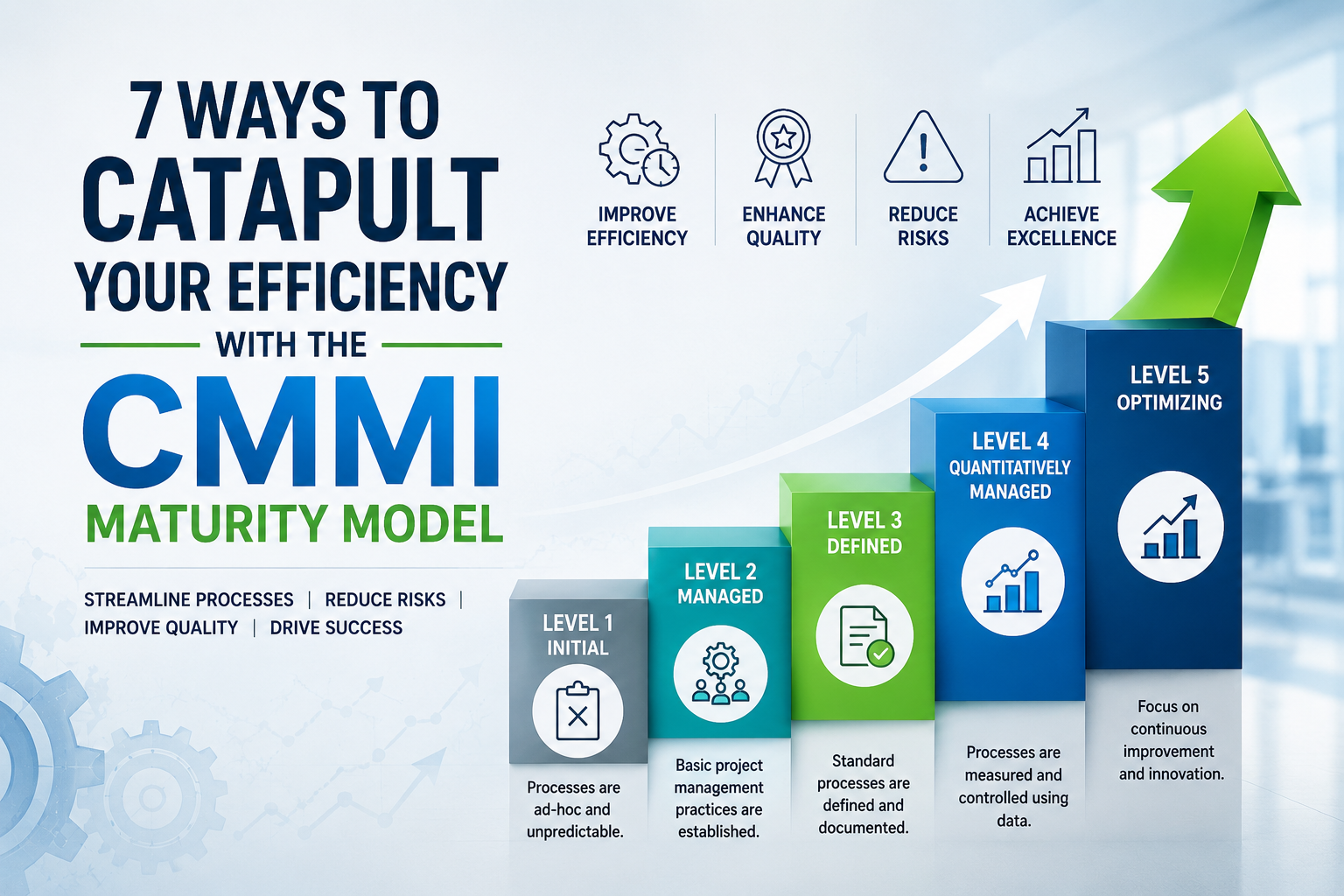
There are five levels of maturity model in the CMMI maturity model. Every tier is a step in the process capability and company growth. The processes of organizations become more stable, predictable and optimized as they pass through these levels.
Level 1 – Initial
At the initial level, the processes are generally unorganized and unpredictable. The work of teams is based on personal work and not on the uniformity of the procedures. At this level, organizations usually have issues of project delays, poor and irregular quality and failure to document.
Level 2 – Managed
At this point, companies start practicing simple project management. Planning and tracking processes occur and teams begin working according to specific instructions. This level brings additional control and visibility in projects.
Level 3 – Defined
At this level, the organizations put down standard processes in the company. Rather than having each team operating in different ways, the organization develops similar processes that are used in the organization. This will provide a greater collaboration and efficiency.
Level 4- quantified managed
At this level, companies apply information and performance metrics to control their activities. Measurable results are used to make decisions and businesses are able to determine inefficiencies and get better results.
Level 5 – Optimizing
The last phase is the one about the constant improvement and the innovation. Organizations keep on examining their procedures and accepting innovations to boost efficiency and productivity.
The important Organizational Benefits.
Application of CMMI maturity model has a number of benefits which assist an organization to develop and stay competitive in the market.
- Greater Process Efficiency: The framework promotes organizations to have organized processes of work and to get rid of inefficiencies. This enhances optimal use of resources and ease of conducting projects.
- Better Quality Management: Process standardization creates a stronger quality control. Teams are able to spot problems at an earlier stage and avoid defects to the end product or service.
- More Customer Confidence: Clients would be willing to do business with organizations that adhere to accepted quality models. Implementation of the CMMI maturity model is an indicator of dependability and professionalism.
- Stronger Risk Management: Organizations are able to prepare ahead and manage risks with well outlined processes. This minimizes project failures and enhances delivery schedules.
- Continuous Improvement: Continuous improvement is among the fundamental tenets of the CMMI maturity model. Organizations are always analyzing their performance and improving the processes to get improved results.
Industries which utilize the Model.
CMMI maturity model is popular amongst industries. Even though it was initially introduced in software engineering, nowadays it is used in most industries.
The framework helps technology companies enhance the practices of software development and produce quality products. It allows IT service providers to handle intricate projects and provide solid solutions. It is implemented by manufacturing organizations to facilitate the operation and make it more efficient.
The CMMI maturity model is also used by the government agencies and consulting firms to improve accountability, transparency, and performance management.
The Certification Process
Companies that would like to be recognized as a result of the process improvement may have a formal assessment to prove that they adhere to the CMMI maturity model. In the process, the practices, documentation, and project management methods of the organization are assessed by trained assessors.
The maturity level that is attained by the organization is determined by the appraisal. Increasing the level of maturity is a measure of greater capability of processes and greater organizational discipline.
Organization certification does not just make an organization committed to quality but also enhances its reputation in the international markets.
Conclusion
In this modern day competitive business world, efficiency, consistency, and quality have to be in the limelight of organizations. The CMMI maturity model offers a systematic approach that assists the companies in attaining these objectives by using rigorous procedures and continuous enhancement.
Using the CMMI maturity model, companies are able to improve the project management process, decrease operational risks, and provide credible outputs to their customers. The framework also makes organizations shift out of the disorganized workflows to optimized processes that can facilitate innovation and ultimate success.
The application of CMMI maturity model is beneficial to companies that wish to establish credibility and enhance performance and compete in the global markets.
Read more about our process improvement framework.
FAQs
1. What is the CMMI maturity model?
The CMMI maturity model is a process improvement framework that helps organizations improve performance, quality, and project management.
2. What are the five levels of the CMMI maturity model?
The five levels are Initial, Managed, Defined, Quantitatively Managed, and Optimizing.
3. Why is the CMMI maturity model important?
It helps organizations improve efficiency, reduce risks, deliver consistent results, and enhance customer satisfaction.
4. Which industries use the CMMI maturity model?
It is widely used in software development, IT services, manufacturing, consulting, and government organizations.
5. How does CMMI improve business performance?
CMMI standardizes processes, improves quality, increases productivity, and supports continuous improvement.
6. What is CMMI certification?
CMMI certification is an appraisal that evaluates an organization’s process maturity and assigns a maturity level.
7. Who should implement the CMMI maturity model?
Organizations looking to improve operational efficiency, product quality, and customer trust can benefit from implementing CMMI.
